
Our Story
150 years of faith, family, and life in the Texas Hill Country.

In this story
Prologue
A Parish at the Heart of the Hills
Honey Creek grew up as a community of German farm families spread across the Hill Country. Their church was the place that brought them together, and for 150 years it has gathered the people of Honey Creek. The parish grounds occupy a limestone rise beside State Highway 46 in western Comal County, where buildings from more than a century of its history stand within sight of one another. The 1904 Chapel of the Immaculate Conception stands on the highest point. Below the chapel are the parish cemetery, where many of the founding German families are buried; the 1912 stone church, built by hand by parishioners; and the main church, dedicated in 2006. Since 1876 the parish has served as the center of a scattered rural community, the place where ranch families gathered, educated their children and buried their dead. In 2026 it marks its 150th anniversary.
Chapter 1 · 1850–1876Where the Bees Were
The parish traces its origins to the German settlement of the Texas Hill Country. In 1850 Christina Bechtold arrived at Galveston from the Duchy of Nassau; her husband and four of their five sons had died during the voyage. Traveling inland with her surviving son, Michael, she married George Friedrich Kunz, a shoemaker, and the family settled in the hills northwest of New Braunfels. According to family accounts, the settlement took the name Honey Creek from a large swarm of bees found at its spring. Other Catholic families followed, among them the Kneuppers, Ackers, Luxes, Mooses and Scheels. Father John Kossbiel, a circuit priest based in Boerne, began celebrating Mass in the Kunz home. On August 20, 1876, he celebrated the first Mass in a log church the families had built. The parish dates its founding to that day.
Read the full chapterClose chapter
 Honey Creek today, in the Honey Creek State Natural Area beside Guadalupe River State Park. According to family accounts, the settlement took its name from a swarm of bees found at its spring around 1850.
In 1850 Andrew Bechtold, his wife, Christina, and their five sons sailed for Galveston from the Duchy of Nassau, in western Germany. According to Joyce Gass Moore’s history of the family, the crossing took thirty-two days. An epidemic on board killed Andrew and four of the boys. Christina, then twenty-seven, landed with her son Michael.
Mother and son traveled by ox wagon to New Braunfels, which German immigrants had founded in 1845. By then most of the land near water had been claimed. Christina joined a group of Catholic settlers heading farther into the hills. Among them was George Friedrich Kunz, a shoemaker who had also emigrated from Nassau. The two married during the journey.
The party rested at a spring called Anhalt, a common stopping place on the road, then continued north onto unclaimed state land. Following a stream toward the Guadalupe River, they reached a spring that flowed from beneath a rock ledge. Texas then granted 160 acres to a married couple who lived on the land and improved it for two years. The Kunz family filed its claim there.
The family’s first shelter was dug into the caliche beneath the ledge; Alfred Engel noted in 1976 that its remains had been visible within living memory. While the adults cut cedar for a log house, Michael and a boy from the neighboring Kneupper family went to the spring for water. They reported a large swarm of bees hanging above it, which left a few days later. According to the account Engel recorded, the boys proposed the name Honey Creek, and it was adopted.
Cash was scarce. Kunz found that cedar charcoal held its heat long enough to warm clothes irons. He hauled it by wagon to San Antonio, Boerne and New Braunfels for sale. Other Catholic families settled nearby: Johann Adam and Margarethe Kneupper, also from Nassau; the Acker, Lux and Moos families; Fritz and Hermann Scheel, whose family arrived in 1868; and a stonemason, Adolph Kaiser.
The families kept the faith at home until priests came. Father Emil Fleury, a French missionary based in Boerne, passed through the settlement in 1869. On a later charcoal trip Kunz met Father John Kossbiel, who had been ordained at Victoria in 1875. Kossbiel rode a circuit that extended from Boerne to Fort McKavett, Fort Concho, Mason, Llano and San Saba. At Kunz’s invitation he celebrated Mass in the Kunz home for the Catholic families of the area, and he agreed to return regularly.
At Kossbiel’s suggestion, the families built a church of cedar logs near the Kunz home, beside a burial ground already in use on Michael Bechtold’s land. Kossbiel celebrated its first Mass on August 20, 1876. Alfred Engel’s centennial history describes that date as “the birthday of St. Joseph’s Church of Honey Creek.” On August 27 Kossbiel married Ferdinand Kaupert and Maria Scheel, the first marriage in the parish register.
Chapter 2 · 1876–1897Mass on Horseback
For its first twenty-two years the parish had no resident priest. The log church burned within a year and was replaced by a second log chapel. In 1878 Johann Adam Kneupper, George Friedrich Kunz and Michael Bechtold built the Kneupper Chapel of hand-quarried limestone; it still stands near the parish’s first cemetery. Priests from Boerne and New Braunfels came whenever they could. In 1892 Father Henry Gerlach moved the parish three miles southeast, to the road between New Braunfels and Boerne, onto land donated by Hermann and Katharine Scheel. A frame church was dedicated there that June. The Altar Society, founded in 1894, is the parish’s oldest organization and remains active today.
Read the full chapterClose chapter
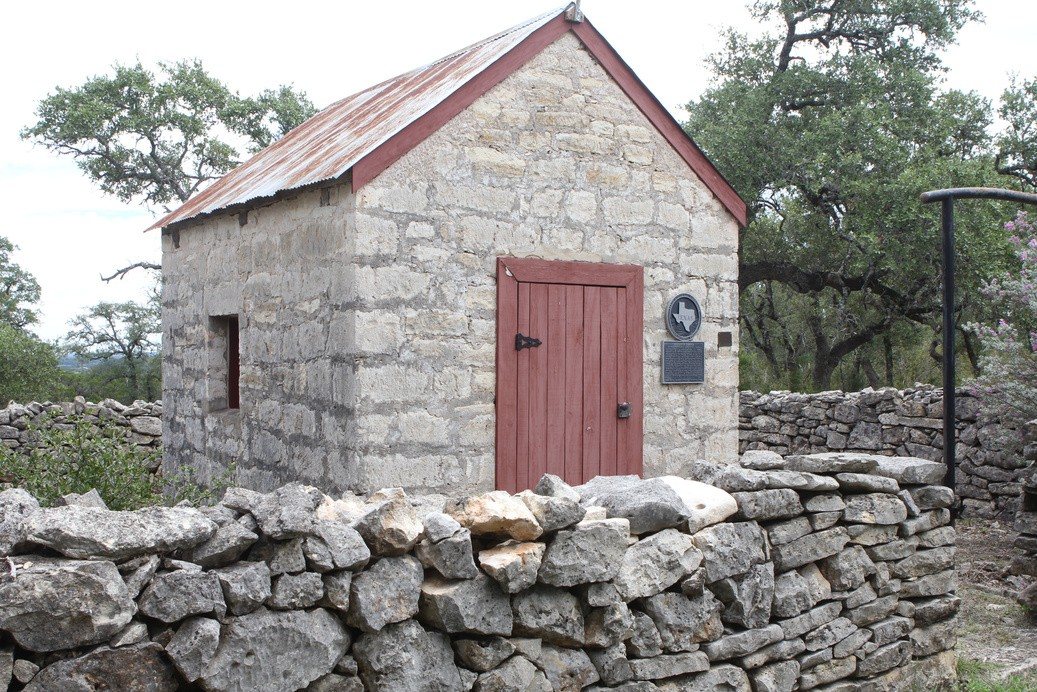 The Kneupper Chapel, built of hand-quarried limestone in 1878. It stands near the parish’s first cemetery off Park Road 31, on private land.
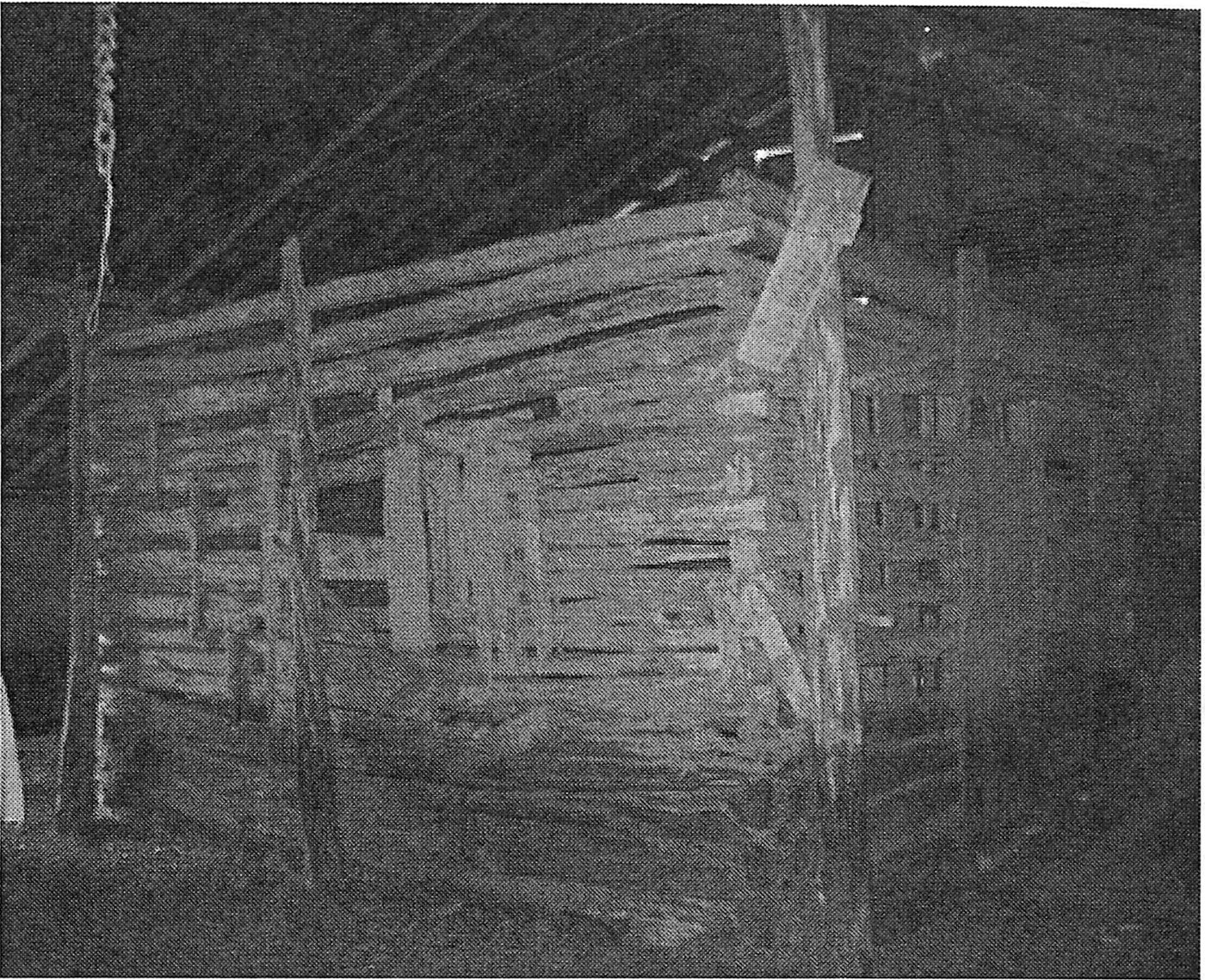
The log church stood for less than a year before it was destroyed by fire. Neither the cause nor the date was recorded. The congregation replaced it with a second log chapel, about sixteen feet square, which held roughly thirty people. After the parish moved in 1892, that chapel was dismantled and reassembled as a barn on the Kneupper farm. Its logs were still visible inside a larger barn on the former Kneupper homestead in 2005.
In 1878 Johann Adam Kneupper gave a hilltop on his farm, about half a mile from the log church, for a chapel of stone. Kneupper, George Friedrich Kunz and Michael Bechtold quarried the limestone by hand, and Adolph Kaiser contributed his skill as a stonemason. Stone buildings were uncommon in the area at the time, when cedar was the usual building material.
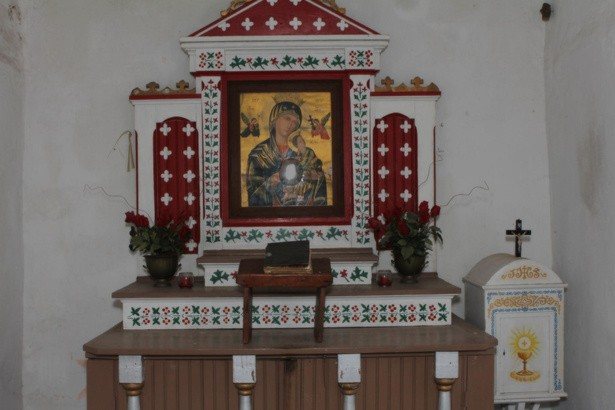
The Kneupper Chapel never served as the parish church. It was used for private prayer when no priest was available, and for weddings and funerals near the old cemetery. Its furnishings consisted of an altar, a kneeling bench, devotional pictures and candlesticks, lit by two small windows. Scheel family recollections include one domestic detail: on days when the family boiled molasses, the boys were allowed to leave the work to pray at the chapel, on condition that they actually prayed.
Until 1898 the parish had no resident priest. Mass was celebrated by visiting clergy: Father Kossbiel from Boerne; Father John Istwan in 1879; priests from New Braunfels in the early 1880s; Father Richard Edgecomb in 1885 and 1886; then Kossbiel again until 1888. Circuit priests carried vestments, altar linens and chalice on horseback and lodged with parish families. For a period Mass was celebrated every third week, with Alfred Scheel serving as altar boy. In his diary Scheel later described the Honey Creek of those years as a lonesome place in the hills, passed by only a few farm wagons.
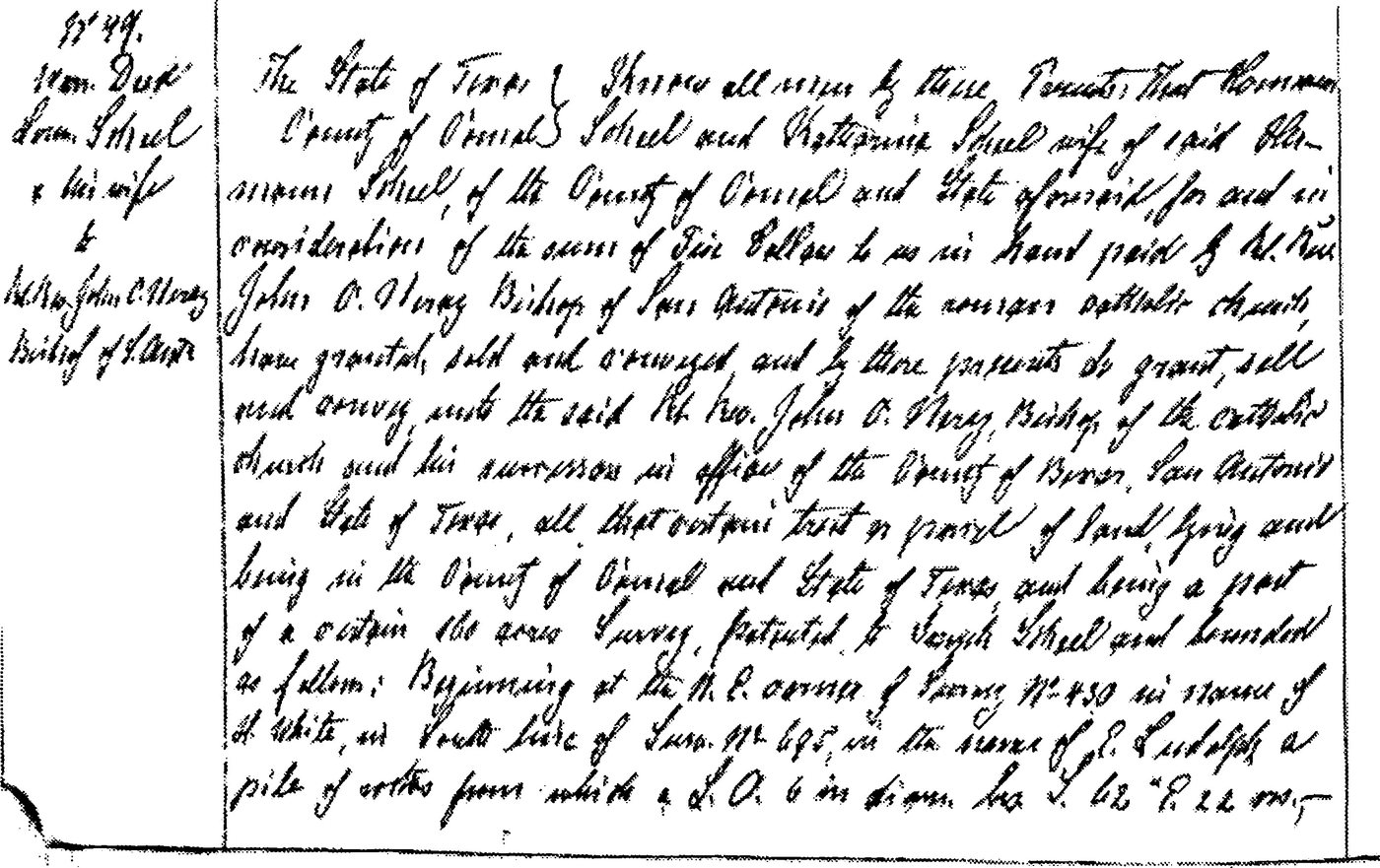
Father Henry Gerlach came from Fredericksburg in November 1891 and, within nine months, relocated the parish. The original site lay two miles from the main road, while newer Catholic families had settled to the south along the upper Cibolo. Gerlach chose a rise three miles southeast, on the road between New Braunfels and Boerne, now State Highway 46. Hermann and Katharine Scheel donated the land. Their deed to the bishop of San Antonio, dated February 4, 1893, records a nominal payment of five dollars. A frame church was built on the site now occupied by the Education Building and dedicated in June 1892. Gerlach was transferred to Meyersville that August.

The parish’s earliest recorded fundraiser took place on July 30, 1893, at the Germania Farmer Hall in Anhalt, where men from St. Joseph’s Church in San Antonio presented a program. In 1894, under Father John Pinnel, the women of the parish organized the Altar Society. It is the parish’s oldest organization and continues to care for the altar linens and to serve a meal after parish funerals.
Several priests served in turn. After Pinnel came Father Huniviller, a Benedictine who played the organ for the congregation’s singing practice, then Father Joachim Huwyler, O.S.B., and Father Francis Neissens. In 1896 Father Kossbiel returned for a third time. He was the last of the circuit priests to serve Honey Creek.
Chapter 3 · 1898–1933Father Draessel’s Hill
Father Virgilius Draessel, a Franciscan from the Austrian Tyrol, arrived in January 1898 as the parish’s first resident pastor and served for thirty-five years. He established a mission at Twin Sisters in 1899, laid out the present cemetery in 1902 and dedicated the hilltop Chapel of the Immaculate Conception on December 8, 1904. His principal work was a limestone church built largely by the parishioners themselves. It measures 33 by 62 feet, with a 72-foot bell tower; the dimensions reflect the traditional ages of Christ, Mary and Joseph. Construction stalled for lack of funds and resumed after Draessel returned from a journey to Austria. The church was dedicated free of debt in 1912. His Diamond Jubilee, marking sixty years as a priest, drew an estimated thousand people in October 1932. He died on October 9, 1933, and is buried beneath the church floor.
Read the full chapterClose chapter
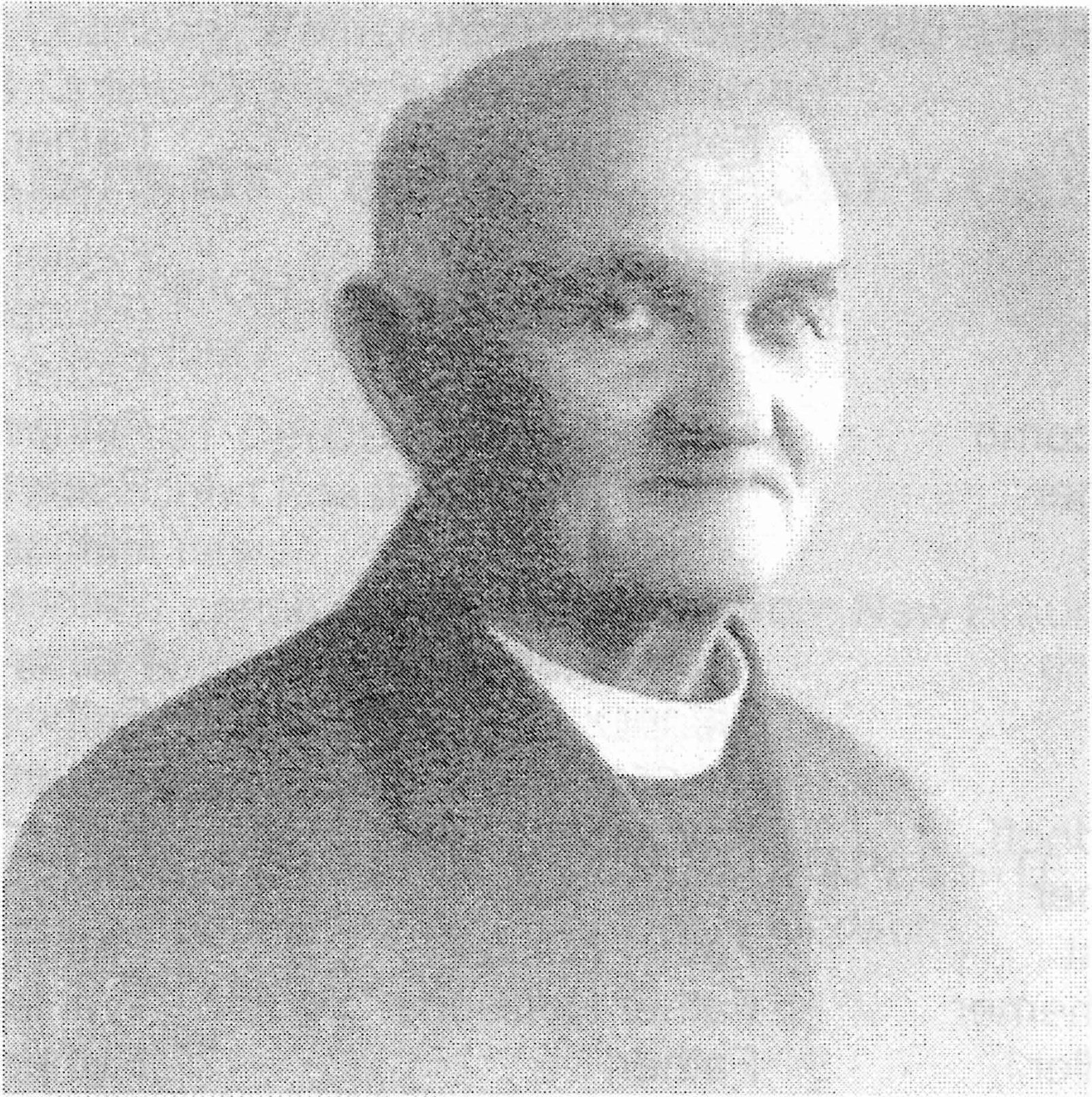 Father Virgilius Draessel (1850–1933), first resident pastor, January 1898 to October 1933. From Wehe and Lindemann, 2005.
Father Virgilius Draessel arrived in January 1898 as the parish’s first resident pastor. A Franciscan from Innsbruck, in the Austrian Tyrol, he was born in 1850 and ordained in 1872, and he had served as a missionary in Egypt. He spoke little English. Alfred Engel recorded that the bishop considered a German-speaking rural parish suitable for him, in part because of his poor health.
The parish then had a frame church and few other buildings. Draessel built a one-room stone house on the hill above the church, much of it with his own labor, and later added a kitchen. The Scheel families supplied him with milk, butter, eggs and bread. In 1898 he organized the young men of the parish into the Sacred Heart Youth Society, the Herz-Jesu-Jünglingsverein. Its members built a barn for his horses and buggy, dug a cistern for rainwater and laid the dry-stone terraces that still stand on the hillside.
Draessel also served outlying settlements. In June 1899 he consecrated a small frame church for ranch families at Twin Sisters, on the Little Blanco River, known as the Marienkirchlein, the Little Church of Mary. He celebrated Mass there about once a month for some three decades. The church survives as St. Mary’s Help of Christians, in what is now the Diocese of Austin. In 1902 he laid out the cemetery on the slope below his house, which remains the parish cemetery.
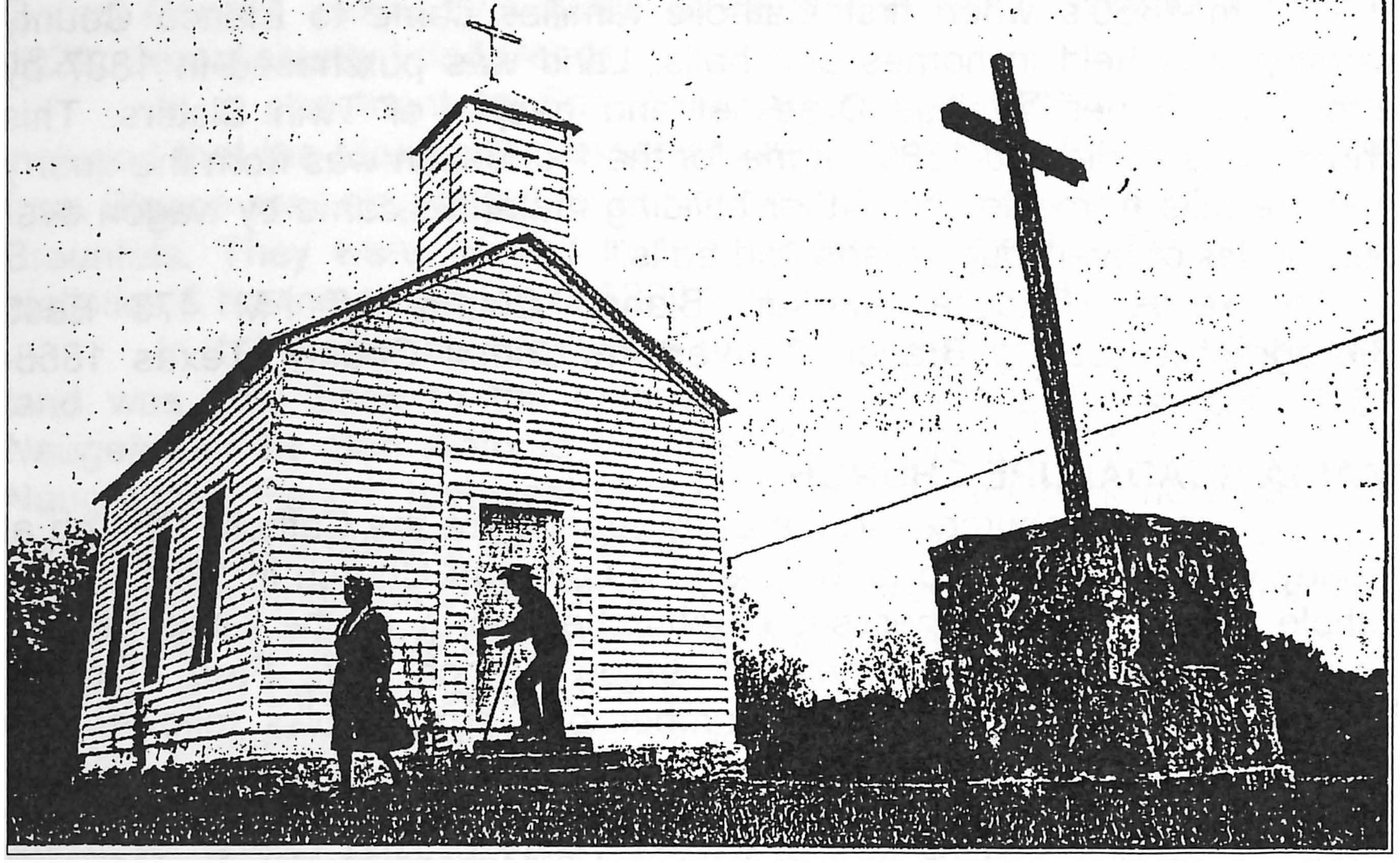
The Chapel of the Immaculate Conception. According to parish tradition, Draessel promised to build a chapel to the Blessed Virgin if his health improved. On the highest point of the grounds he built a one-room chapel of native limestone and timber, dedicated to the Immaculate Conception on December 8, 1904. The date marked the fiftieth anniversary of Pope Pius IX’s definition of the dogma. The chapel overlooks the parish grounds and, on clear days, the peaks of the Twin Sisters. A boulder outside bears the carved date “1896,” whose meaning is not known.
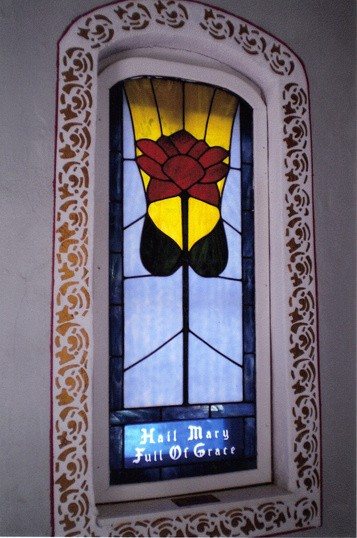
The chapel was later restored in memory of Bulmaro Alarcon Jr., who died in a plane accident. His father, Bulmaro Alarcon, led the work, and his brother Mark painted the interior by hand. Ron French rebuilt the stonework using stones from the original walls, and Don Gustin made the benches. Edith Zaiontz designed the rose windows, which she and her husband, Kevin, donated. The chapel is open daily for prayer.
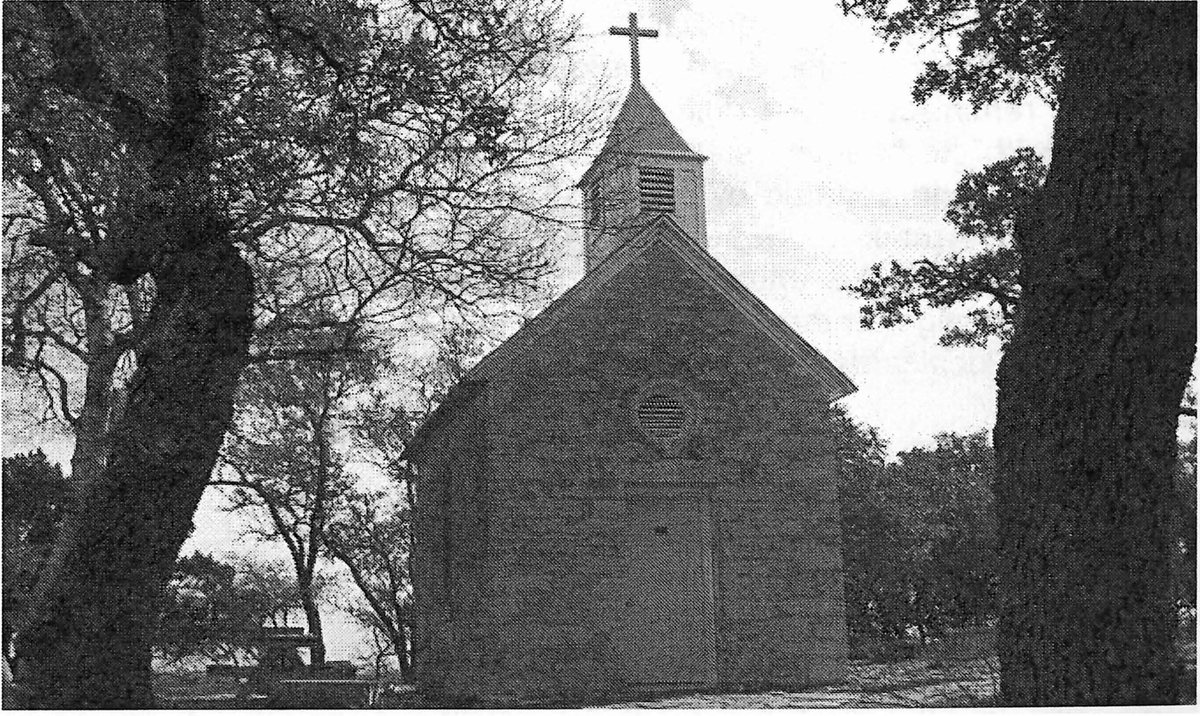

The stone church. Draessel’s largest project was a stone church to replace the frame building. Its dimensions were chosen for their symbolism: 33 feet wide, for the traditional age of Christ at his death; 62 feet long, for the traditional age of the Blessed Virgin; and a bell tower 72 feet high, for the traditional age of St. Joseph.
With little money available, the parish contributed labor. Men hauled limestone by wagon from nearby ranches. Accounts differ on its source: Scheel family members recalled that the stone came from Hermann Scheel’s land, while Adolph Scheel named the Simon Laubach ranch. The blocks were split with hand drills, hammers and chisels, some to three feet in length, and laid in walls fifteen inches thick with mortar made from local caliche. Construction began around 1909; the sources give dates from 1908 to 1911.
Work stopped with the walls about half complete. Funds were exhausted, the men were needed for field work, and, as Engel noted, not all parishioners supported the project. Draessel traveled home to the Tyrol. Parish accounts relate that while there he climbed a mountain he had climbed as a boy, to pray for the parish and its unfinished church. Work resumed after his return, and the church was dedicated free of debt in 1912.

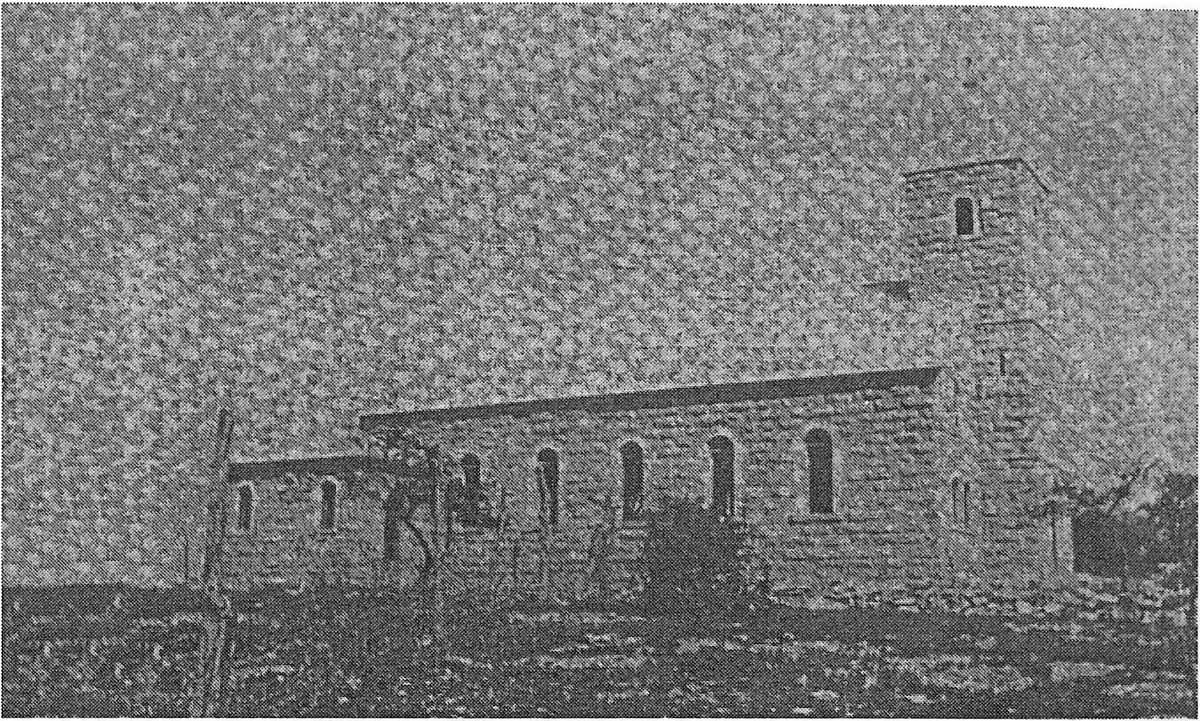
The interior was decorated by John Pazdernik (1870–1951), an Austrian-born painter who lived at Anhalt. He applied hand-cut stencils and painted trim to the walls and ceiling, as he did in many houses in the area, and also painted Alpine landscapes for local families. Pazdernik, who never married, left his homestead to the parish and is buried in its cemetery. His stencil work was later painted over and was uncovered during a restoration.
Missions and jubilees. The Mexican Revolution (1910–1920) brought Mexican families to the Hill Country to farm and work. Around 1920 Draessel built a wooden chapel for them at Spring Branch, dedicated to Nuestra Señora de Guadalupe and funded by donors in the northern states. In 1928 William Neugebauer deeded its one-acre site to the bishop for one dollar. Priests from Honey Creek celebrated Mass there on Saturday mornings into the 1950s.

On October 22, 1922, the parish observed the fiftieth anniversary of Draessel’s ordination. Bishop Arthur J. Drossaerts of San Antonio presided at a pontifical High Mass, and Alfred Engel described the occasion as the largest celebration held in Honey Creek to that date. The St. John’s Men’s Society built a parish hall for the jubilee and named it St. John’s Hall. In 1926 parishioners formed a church band. Its founding members were Eugen, Alfred, Alex, Bernard, Albert and John Scheel; Rudolph Engel; Emil Laubach; Alfons Schwarz; Fritz Grosser; and Gus Kanz.

Final years. In old age Draessel continued to celebrate Mass daily, often, by his own account, with no congregation present. He commissioned a coffin from William Specht, a local craftsman, and kept it in the bell tower for several years. He also had his tomb prepared beneath the floor of the church.
Adolph Scheel, interviewed in 2002, recalled driving Draessel to San Antonio in a Model T Ford for a fee of two dollars a trip. On one occasion the engine would not start; Draessel concluded that it needed water, filled the radiator from a bucket and had Scheel crank it again, and the engine started.
The parish celebrated Draessel’s Diamond Jubilee, marking sixty years as a priest, on October 26, 1932. Drossaerts, by then archbishop, attended with about forty priests, and Engel estimated the crowd at about a thousand. Father Henry Gerlach, who had moved the parish to its present site forty years earlier, celebrated an outdoor Mass. The San Antonio photographer E. Raba made the panoramic photograph shown at the top of this page.
In 1933 Draessel’s health failed. He declined to enter a hospital and asked to remain near the church. Alex Scheel took him into his home and cared for him there until his death on October 9, 1933, at eighty-three. In keeping with his wishes, he was buried beneath the floor of the church near the altar. His memorial plaque was later moved from the floor to a nearby pew.
He was a hard man to get along with, but they respected and loved him anyway.
Adolph Scheel, recalling Father Draessel, 2002
Chapter 4 · 1913–1950The Schoolhouse Bell
In 1913 the former frame church became St. Anthony School. Two teaching Sisters taught all grades in a single classroom. They came first from the Sisters of Divine Providence and, from 1934, from the Sisters of the Incarnate Word and Blessed Sacrament of Victoria. Enrollment averaged about twenty pupils. Parish families supplied the teachers with food and raised money for the school through plays and other events. Prayers were taught in both German and English. As rural enrollment declined in the 1940s, the Sisters’ religious community recalled its teachers, and the school closed in May 1950. The Education Building, dedicated in 1998, occupies the school’s former site.
Read the full chapterClose chapter
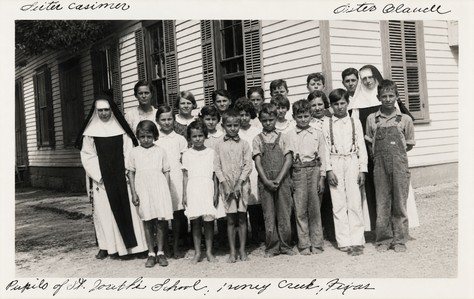 “Pupils of St. Joseph School, Honey Creek, Texas,” with their teaching Sisters, before the frame building that served as the parish church from 1892 to 1912.
After the stone church opened, the 1892 frame church was converted into St. Anthony School in 1913. One end served as the classroom and the other as living quarters for the teachers, two Sisters of Divine Providence from Our Lady of the Lake in San Antonio. They taught all grades together in one room, to an average of about twenty pupils a year. Parish families provided much of their food; Thekla Wehe and other women regularly brought milk, eggs, cheese and bread to the Sisters and the pastor.
The school day followed the bells in the new tower. Of the church’s three bells, two called the parish to Mass, and the third, the death bell, was rung for funerals as processions went to the cemetery. At noon on school days a pupil rang the Angelus with nine strokes. Hilmar Wehe, one of the bell ringers, recalled that a boy who rang a tenth stroke lost his lunch. Children learned their prayers in German and English and attended Mass in Latin. Boys became altar servers at about age seven, after their First Communion, and served at weddings and funerals as well as Sunday Mass.
In September 1934 the Sisters of the Incarnate Word and Blessed Sacrament, from Victoria, took over the teaching. Parents staged plays to raise money for the school, including Look Out Lizzie and Good Gracious Grandma. Margaret Scheel, later the parish organist for thirty-eight years, appeared in them as a pupil.
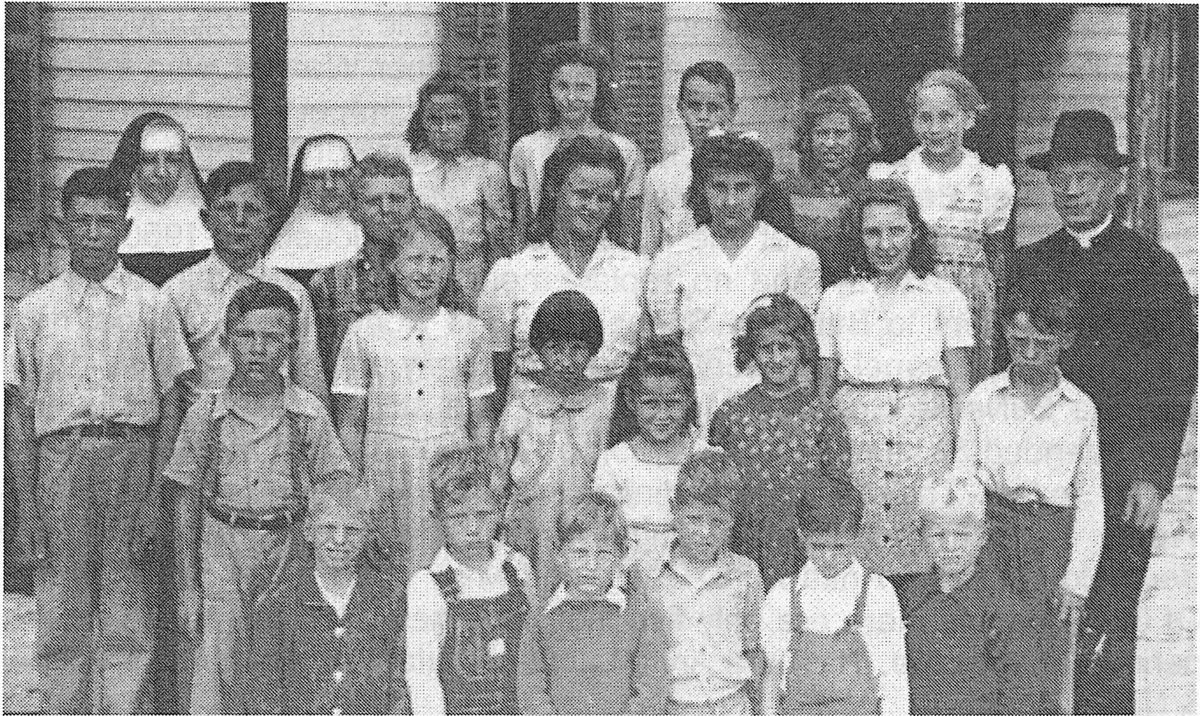
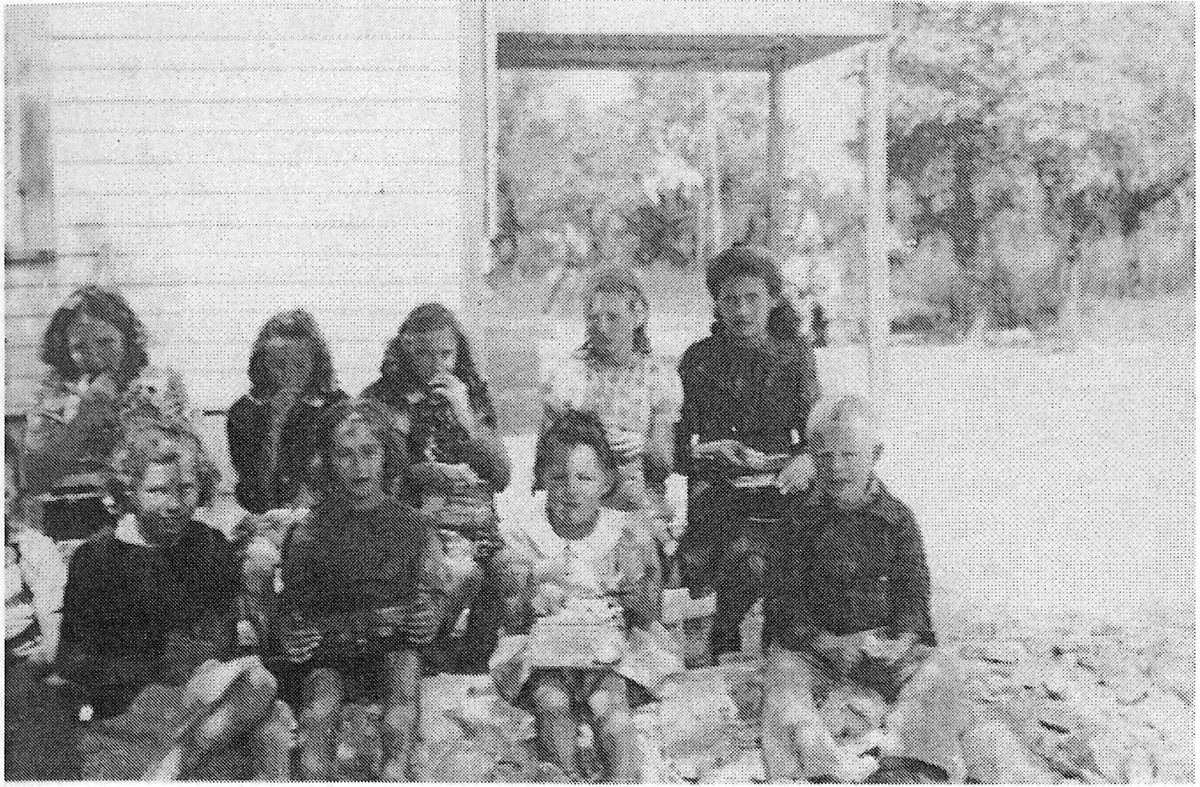
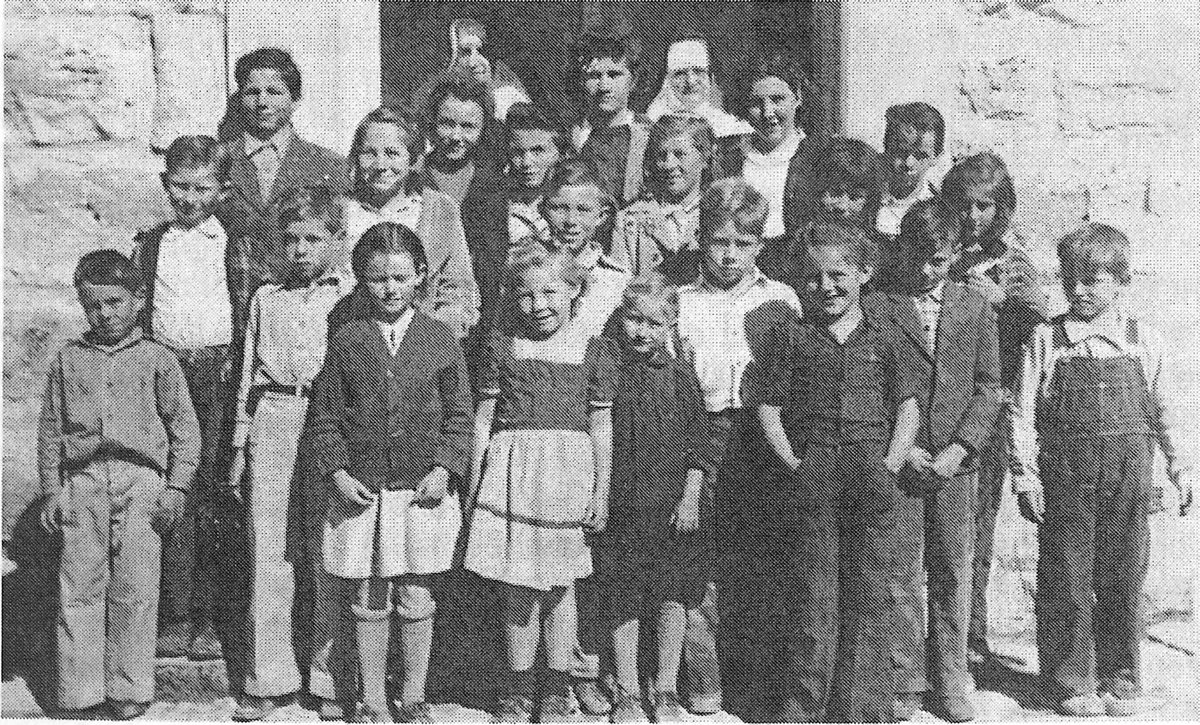
Enrollment declined in the 1940s. In a 1942 report, Father Wahlen noted that fewer than six pupils lived within walking distance of two to three miles; the others came by car or boarded with nearby families. Enrollment reached twenty-five in 1946 and fell after that. On April 6, 1950, Mother M. Gerard, superior general of the Sisters, wrote to Archbishop Robert E. Lucey that she needed the two teachers at schools with larger enrollments. “To close any school is a painful experience,” she wrote. Sister Bernard and Sister Anthony completed the school year in May 1950, and the pupils transferred to the school in Bulverde.

The school building was later dismantled and its lumber reused on the parish grounds. The Education Building, dedicated September 12, 1998, now stands on the site, which has been used for worship and instruction since 1892.
Chapter 5 · 1933–1974A Country Parish
After Draessel’s death the Missionaries of the Holy Family, based in New Braunfels, administered the parish until 1954, when it passed to priests of the Archdiocese of San Antonio. In the 1940s the parish covered roughly four hundred square miles and numbered about three hundred members. The annual festival grew out of a short-lived parish rodeo of the mid-1930s. A farm road, now State Highway 46, opened past the church in 1948. By 1960 the parish counted sixty-one families. In 1964 its pastor, Father Henry Hilscher, died in office at thirty-six. That same year the parish began introducing the reforms of the Second Vatican Council, turning the altar to face the congregation.
Read the full chapterClose chapter
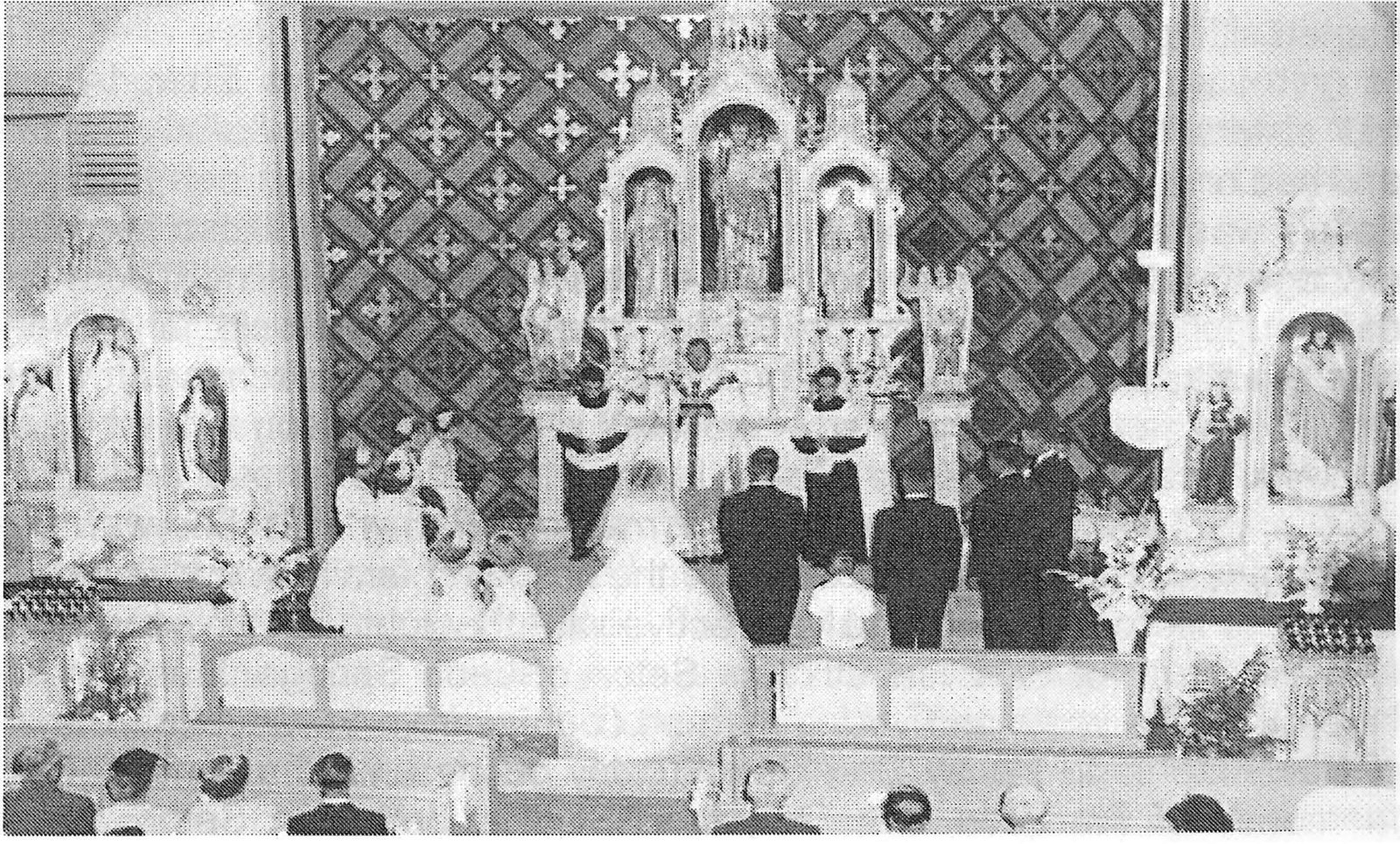 The stone church in August 1960, at the wedding of Hilmar and Barbara Wehe, with its high altar and statues in place. In 1964 the altar was turned to face the congregation and the statues were removed. From Wehe and Lindemann, 2005.
After Draessel’s death the parish was served for two decades by the Missionaries of the Holy Family, a congregation of German priests based at Holy Family Church in New Braunfels, who had assisted him in his last years. Fathers Paar and Lucassen each served briefly, followed in 1934 by Father George Guenther. Father P. J. Roebrocks, pastor from 1937 to 1940, was remembered by parishioners as “our hunter priest”; on some Sundays, according to Scheel family accounts, Mass waited for his return from hunting. He also built the stone church at Blanco. Guenther returned in 1940 and died suddenly in July 1941.
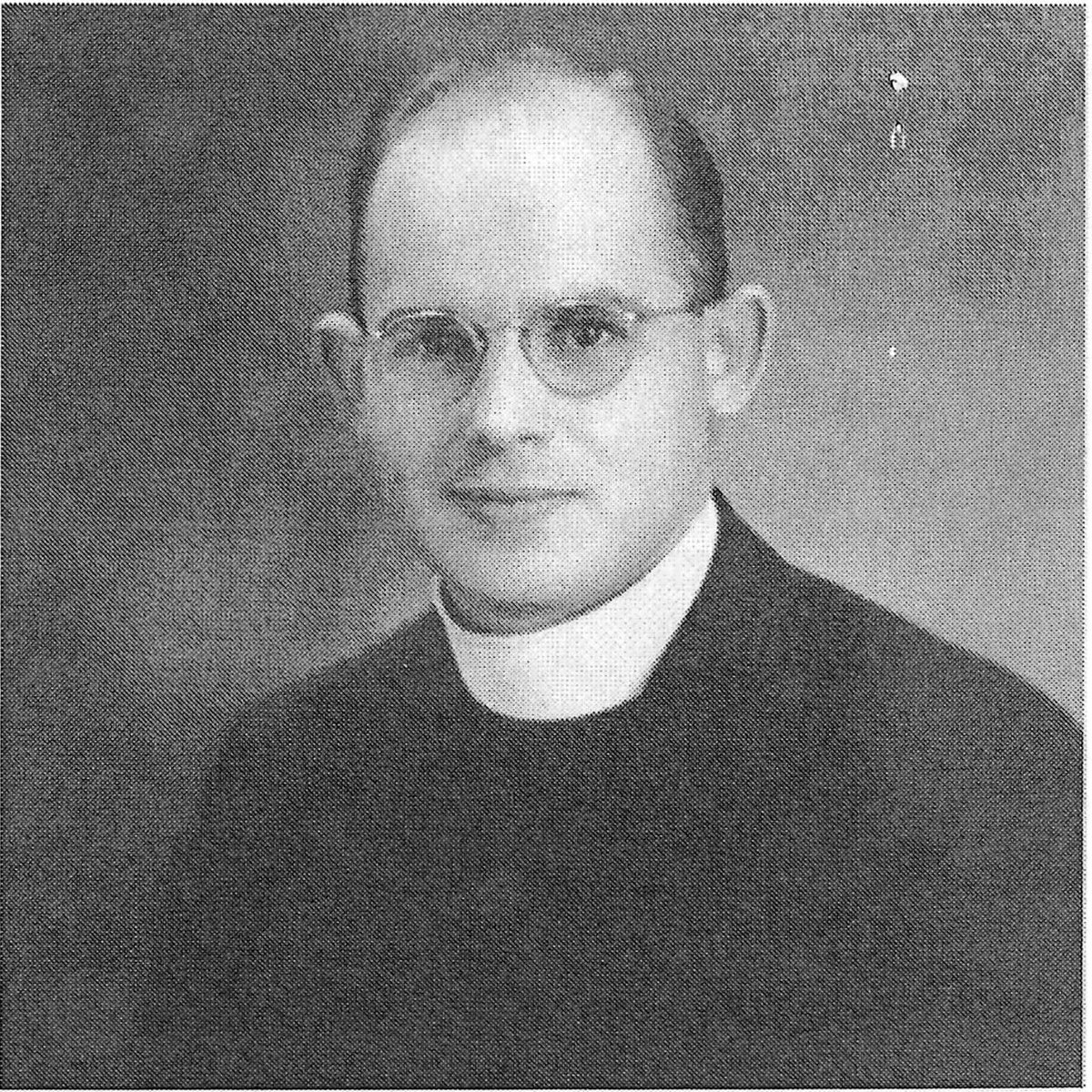

Father Joseph J. Wahlen became pastor on October 15, 1941, and served for thirteen years. Born at Reinsfeld, in the Diocese of Trier, Germany, he served as a soldier in the First World War and was held as a prisoner of war from 1917 to 1920. He was ordained in 1926 and later studied history at Saint Louis University. During his pastorate the parish covered about four hundred square miles in parts of Comal, Kendall, Bexar and Blanco counties and numbered about three hundred members, roughly a fifth of them Hispanic. Wahlen also revived an annual spring service at the Kneupper Chapel.
The parish festival took shape during these years. In 1934 and 1935 parishioners built rodeo grounds half a mile west of the church. The rodeo proved costly and hazardous and was replaced by a bazaar on the church grounds. Men butchered and roasted a calf, women prepared the side dishes, and the meal was served in mid-afternoon. By 2005 the festival served about 1,000 pounds of pot roast, 1,100 pounds of chicken and 800 pounds of potato salad. It remains an annual event.
In September 1948 a new farm road opened past the church, linking Seguin, New Braunfels, Boerne and Bandera; it is now State Highway 46. The same year, Blanco County was transferred to the newly created Diocese of Austin. In 1953 the parish enlarged its cemetery after all existing plots had been sold. In 1954 the Holy Family Fathers withdrew, and the parish was assigned to priests of the Archdiocese of San Antonio.

Some older customs continued into the 1950s. Men sat on one side of the church and women and children on the other until Linda Neugebauer, the mother of seven daughters, asked her husband to sit with the family; others followed. In 1958 Father Patrick Palmer replaced the original pews with new ones fitted with clips for men’s hats. On the feast of Christ the King, parish societies carried their banners in a Rosary procession from the church to the hilltop chapel.
Father Henry Hilscher became pastor in 1959 and was known for his work with young people. When he married Hilmar and Barbara Wehe in 1960, he told them they were the parish’s sixty-first family. On Sundays he celebrated Mass at Honey Creek and then at the parish mission in Leon Springs; on Saturdays he celebrated it at the Guadalupe chapel in Spring Branch. Parishioners built a new parish hall during his pastorate and paid for it in full. On March 13, 1964, Hilscher died of a heart attack while playing baseball with children from the Leon Springs mission. He was thirty-six. The Spring Branch chapel closed after his death; in 1970 its land was sold back to the Neugebauer family, and the building, its steeple removed, became a hunting cabin.
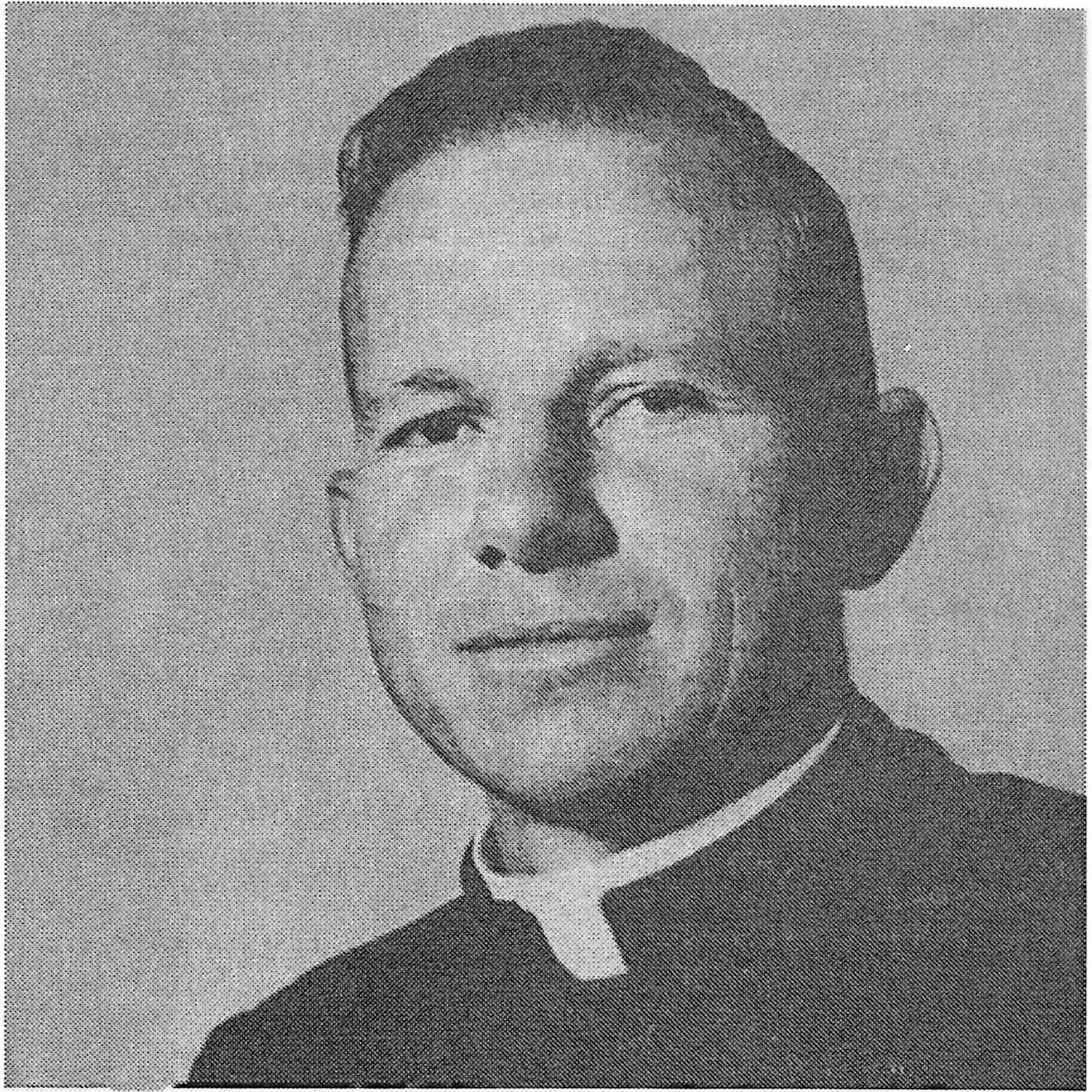
The liturgical reforms of the Second Vatican Council reached the parish in 1964. Under Father Henry Hug the altar was turned to face the congregation, the statues were removed, and the interior took on much of its present form. Monsignor Aloysius Leopold became pastor in 1967. His housekeeper, Rose Sinkul, known in the parish as Miss Rose, cared for the church linens in the small guest house Draessel had built for visiting priests, which was later torn down. In 1966 Barbara Wehe began teaching religious education, and Margaret Scheel Stapper began thirty-eight years as parish organist. By 1972 the parish numbered seventy-six families.
Chapter 6 · 1974–2006The Hill and the Valley
From the 1970s onward, suburban growth north of San Antonio transformed the parish. Membership rose from 142 families in 1977 to about 865 by 2005. Monsignor Bernard Mullaney, pastor from 1974 to 1986, led the volunteers who built the Hill of the Cross, an outdoor Way of the Cross dedicated in 1985. During his tenure the parish’s first permanent deacons were also ordained. Monsignor Terence Nolan served as pastor from 1986 to 1995. Monsignor James Janish, pastor from 1995 to 2007, oversaw the Education Building, dedicated in 1998. He also led a capital campaign, launched in 2002 under the motto “Not Equal Gifts, But Equal Sacrifice,” that funded a new church. Archbishop José H. Gomez dedicated it on August 13, 2006.
Read the full chapterClose chapter
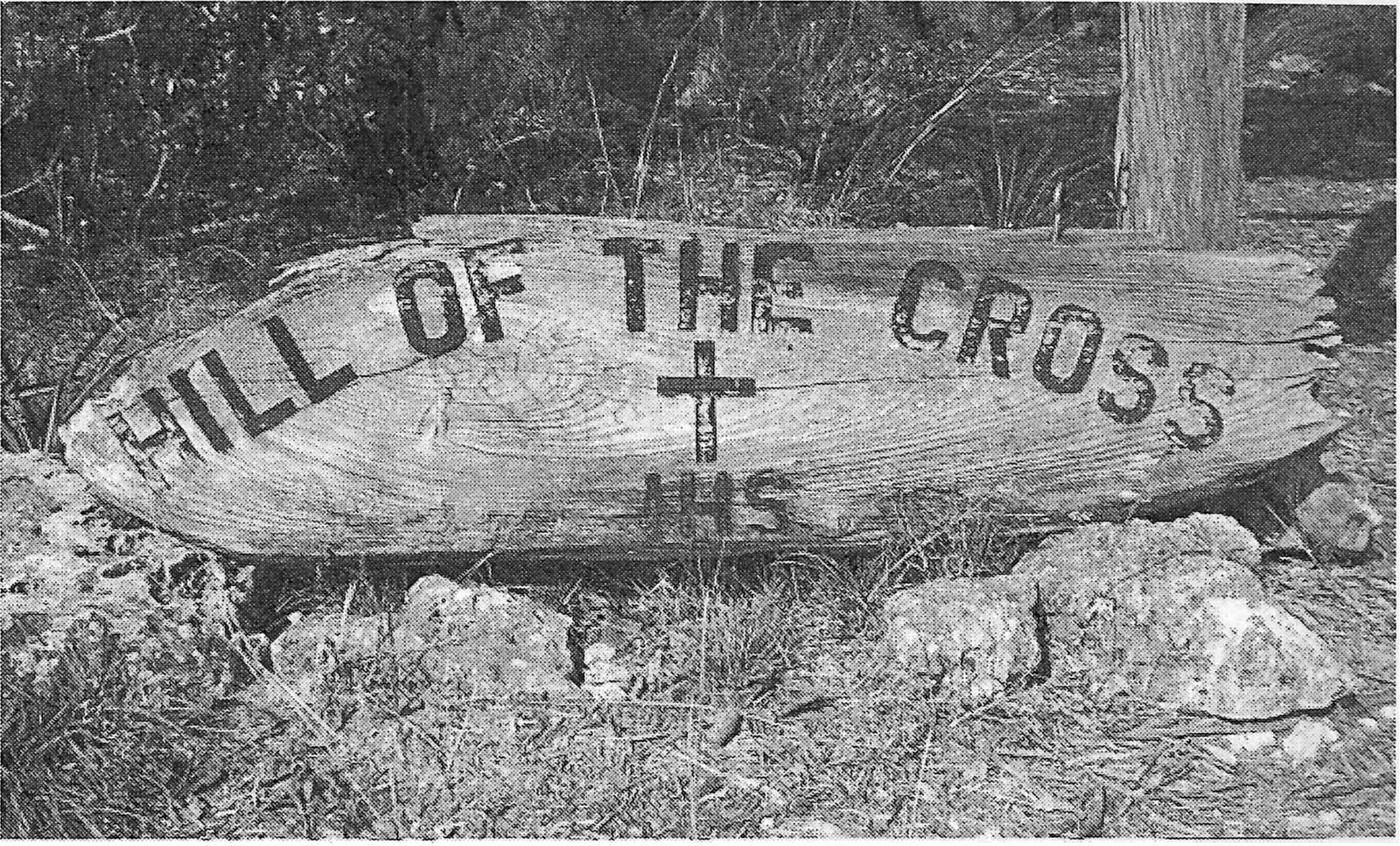 The sign at the entrance to the Hill of the Cross, an outdoor Way of the Cross built by parish volunteers and dedicated June 1, 1985. From Wehe and Lindemann, 2005.
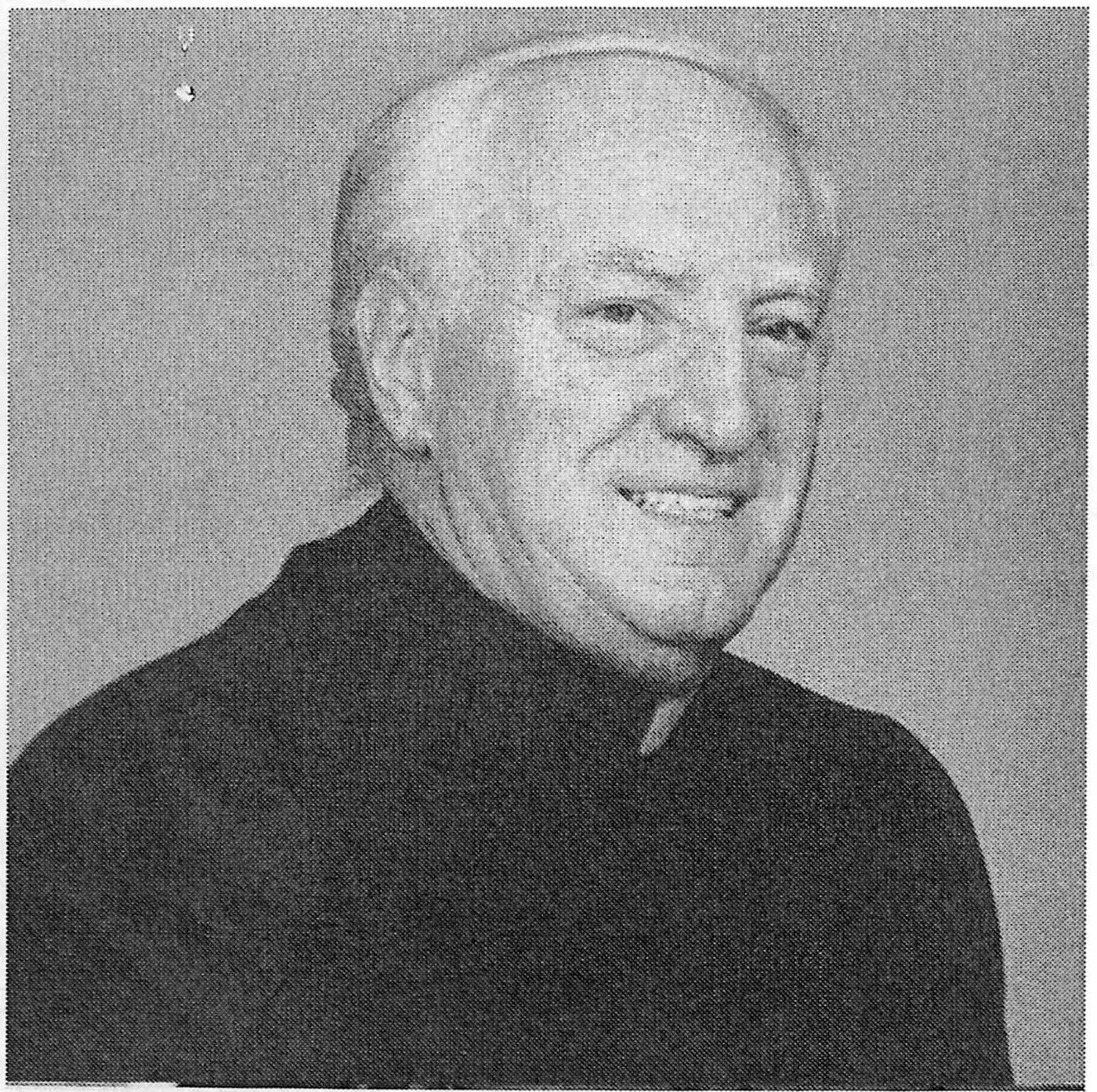
Monsignor Bernard Mullaney became pastor in May 1974 and served for twelve years. He had contracted polio as a child. In 1950 he declined a scholarship to study opera at Syracuse University and entered the seminary, as one of the first students with a disability admitted to a Catholic seminary. Ordained in Boston in 1958, he served for more than thirty years as a judge of the archdiocesan marriage tribunal. His mother, Rose Parrino, kept house for him at Honey Creek. Both are buried in the parish cemetery.
Mullaney was pastor during the parish’s centennial in 1976, when Alfred Engel compiled the first written history of St. Joseph’s. He introduced a Children’s Mass on Christmas Eve in which a pageant replaces the homily. He also began an ecumenical Good Friday observance at which members of St. Paul Lutheran Church and the Methodist church in Bulverde pray the Stations of the Cross with the parish, followed by lunch in the parish hall.
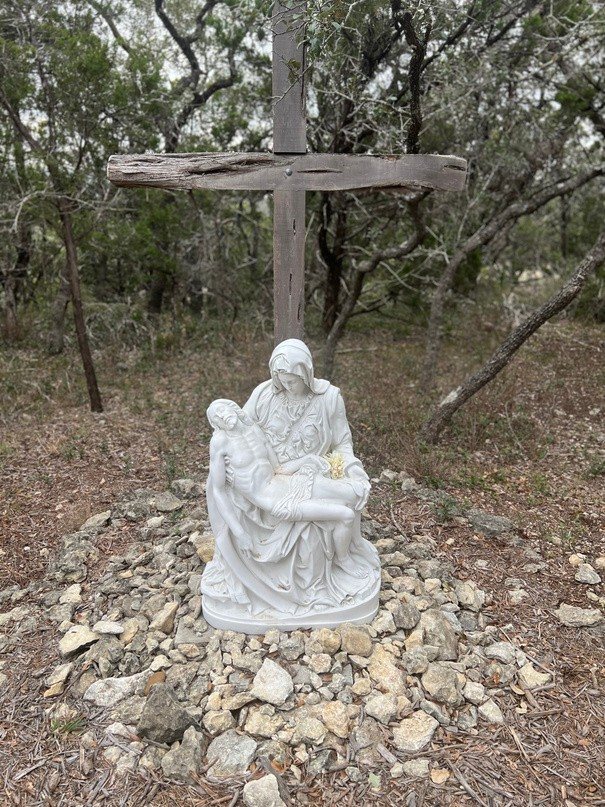
The Hill of the Cross. East of the church lay wooded, rocky land unsuited to farming. Mullaney and a planning committee led by Deacon James Legendre and his wife, Arlene, with Joyce Gass, Rosalie Bushick, Arthur J. Schmidt and Joe Kaizen, proposed an outdoor Way of the Cross there that would leave the land as close to its natural state as possible. The committee surveyed the site repeatedly before fixing the location of each station.
Volunteers cut and stripped cedar for the crosses and benches and used cypress logs for additional seating. Members of the parish youth group removed rocks from the path and used them to line its edges. Parishioners built a stone tomb at the end of the route. According to the committee, many suppliers returned their invoices marked “paid in full.” Archbishop Patrick Flores dedicated the Hill of the Cross on June 1, 1985. During Lent the Stations are prayed there in English and Spanish.

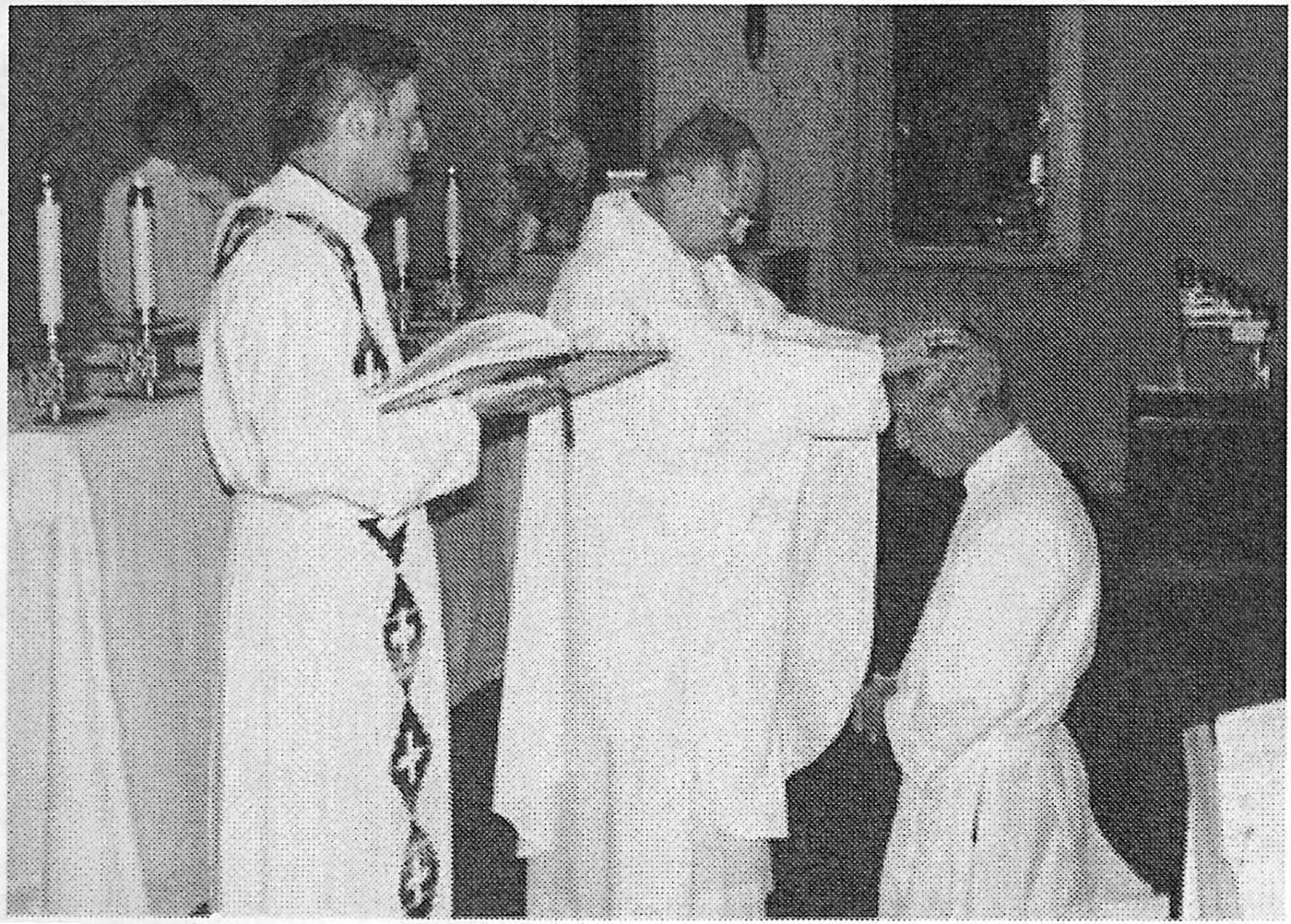
The parish’s first permanent deacon, Jim Legendre, was ordained by Archbishop Flores on April 5, 1982. Johnny Gass, whose family had restored the Kneupper Chapel, was ordained on June 7, 1987, and Joe Kaizen was also serving as a deacon by that year.
Suburban growth north of San Antonio, particularly around Bulverde, increased the parish’s size steadily. It numbered 142 families in 1977 and 271 in 1986. Monsignor Terence Nolan, a canon lawyer from County Mayo, Ireland, became pastor in 1986; he also directed the archdiocesan marriage tribunal three days a week. He hired the parish’s first pastoral assistant. By 1992 the parish had 381 families.
Monsignor James Janish became pastor in June 1995 and served until 2007. The Education Building and parish office were dedicated on September 12, 1998. Membership reached 628 families in 1997 and about 865 in early 2005. By then the parish celebrated six weekend Masses, and the stone church could not seat the congregation; on Easter Sunday worshipers stood outside the doors.
In January 2002 the parish launched a capital campaign, Build for a Faithful Future, under the motto “Not Equal Gifts, But Equal Sacrifice.” On April 27, 2003, about two hundred parishioners attended an outdoor Mass and potluck on the proposed building site. Half of the funds had been raised by 2004, when construction began. The church was designed by Morkovsky & Associates, the firm of parishioner Mark Morkovsky. Archbishop José H. Gomez dedicated it on August 13, 2006. Because the parish would keep both churches in use, the archdiocese granted permission for two tabernacles. The stone church became the Day Chapel.

Chapter 7 · 2006–todayA Church for a Growing Valley
The main church was designed to complement the 1912 church, which now serves as the Day Chapel. Its twenty stained-glass windows, made by Cavallini Stained Glass Studios of San Antonio, trace the story of salvation from Creation to Pentecost and conclude with two windows depicting the parish itself. Newer places of prayer on the grounds include the Labyrinth of Hope (2012), the Garden of Gethsemane (2020) and the Walk with Mary Rosary Garden (2022); the last two were Eagle Scout projects. Today the parish numbers more than a thousand families and celebrates Mass in English and Spanish. During its 150th anniversary year, the parish planned a new panoramic photograph, echoing the one taken at Father Draessel’s jubilee in 1932.
Read the full chapterClose chapter
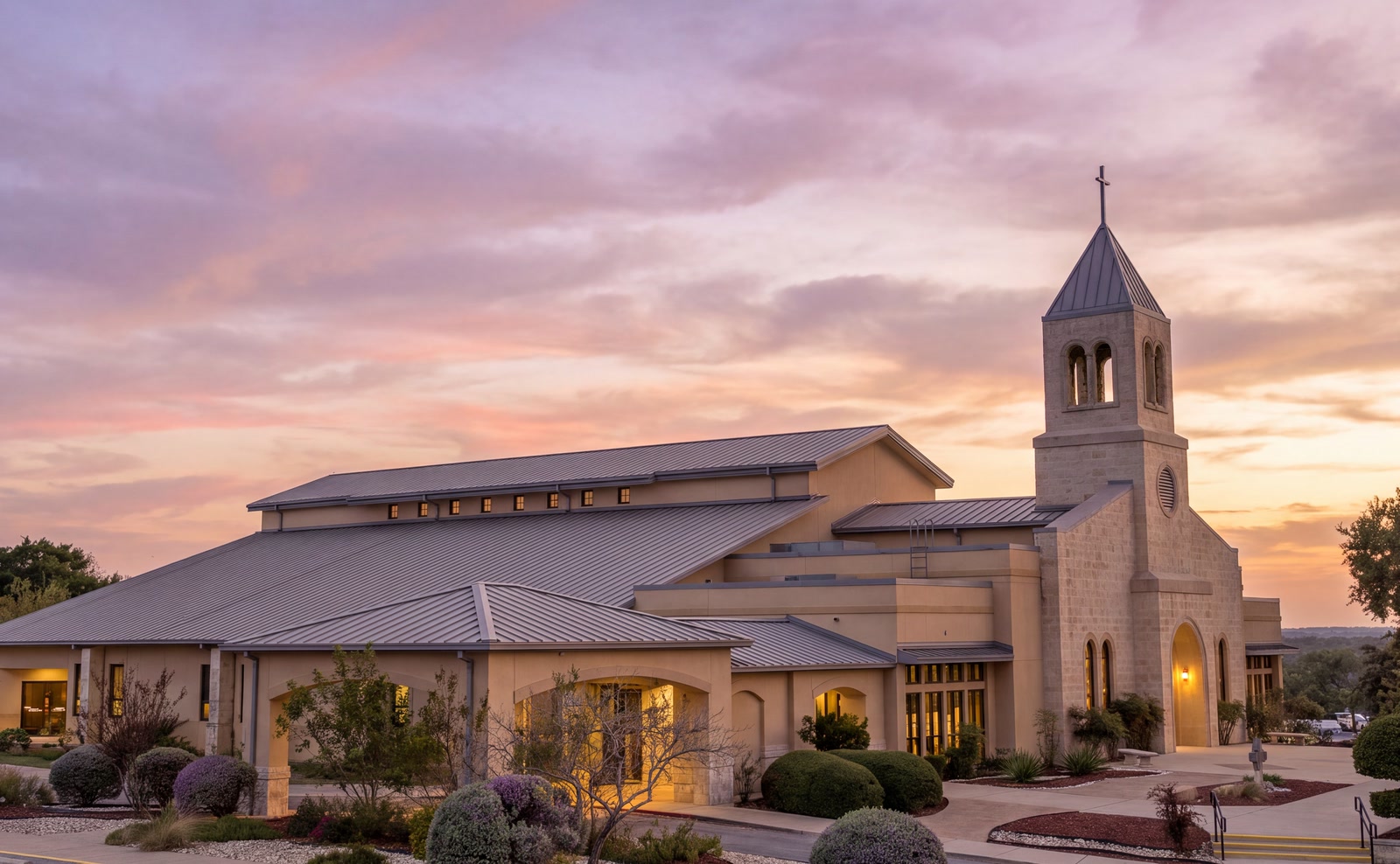 The main church, dedicated August 13, 2006.
The main church was designed to relate to the 1912 church rather than compete with it. A stained-glass transom over the main entrance depicts the lily associated with St. Joseph and the roses associated with Mary; the rose stems repeat the vine motif in the window above the Day Chapel door. Etched-glass angels inside the church refer to the Eucharistic Prayer, which asks that the Church’s offering be carried by angels to the altar of heaven. Parishioner Michael James built the altar, ambo, presider’s chair, candle holders and deacons’ chairs.
The church’s twenty stained-glass windows were made by Cavallini Stained Glass Studios of San Antonio. Monsignor Janish and a committee of four parishioners selected their subjects. The sequence begins with the Old Testament (Creation, Noah, Abraham, Moses and the return from exile), continues with the Holy Family (the angel’s appearance to Joseph, the Nativity and the flight into Egypt) and the life of Christ from his Baptism to Pentecost, and concludes with two windows depicting the parish: St. Joseph – Honey Creek: The Beginning and St. Joseph – Honey Creek: Today. The windows were installed during Lent of 2007, before the first Easter celebrated in the new church. Their donors and the people they memorialize are recorded in a brass book in the Gathering Space.
Several places of prayer have been added to the grounds since 2006. In March 2012 Fred Salazar built the Labyrinth of Hope in memory of David Michael Siller, grandson of Deacon Ken and Vickie Nickel; Archbishop Gustavo García-Siller dedicated it. In spring 2020 Eagle Scout Justin Self of Troop 501 and his family built the Garden of Gethsemane, with site work donated by Gerald Beckman and benches given by Catholic Life Insurance Branch 38. In June 2022 Eagle Scout Michael C. Juarez of Troop 309 completed the Walk with Mary Rosary Garden, whose stones mark the six Our Fathers and fifty-three Hail Marys of the Rosary.
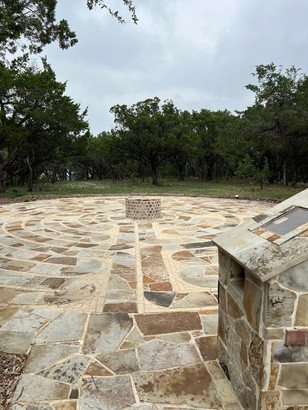


The parish now numbers more than a thousand families and is served by Father Christopher Muñoz and Father Abraham Pendlikatla. Mass is celebrated in English and Spanish, and more than twenty ministries are active. The Chapel of the Immaculate Conception, the Day Chapel and the cemetery all remain in use. Father Draessel’s tomb lies beneath the Day Chapel floor, near the altar. During its 150th anniversary year, the parish planned a new panoramic photograph, echoing the one taken at Father Draessel’s jubilee in 1932.
Not Equal Gifts, But Equal Sacrifice.
motto of the 2002 campaign that built the main church
Explore the parish history
Sacred places
| Place | Built | What to look for |
|---|---|---|
| Main Church | 2006 | Twenty Cavallini windows, including two that tell the parish’s own story; the lily-and-rose transom over the entrance; altar and ambo by parishioner Michael James |
| Day Chapel (the 1912 stone church) | 1909–1912 | Built by hand by parishioners; 33 × 62 feet with a 72-foot tower; John Pazdernik’s stencils; the saints of the Window to the Past series; Father Draessel’s tomb beneath the floor near the altar |
| Chapel of the Immaculate Conception | 1904 | Father Draessel’s thanksgiving chapel on the highest hill; rose windows by Edith Zaiontz; open daily |
| Parish Cemetery | 1902 | The founding families’ graves, including John Pazdernik’s and Monsignor Mullaney’s |
| St. John’s Hall | 1922 | Built by the St. John’s Men’s Society for Father Draessel’s Golden Jubilee |
| Education Building | 1998 | Stands where the 1892 frame church and St. Anthony School stood |
| Hill of the Cross | 1985 | Fourteen cedar Stations and a stone tomb, built by volunteers |
| Labyrinth of Hope | 2012 | Built by Fred Salazar in memory of David Michael Siller |
| Garden of Gethsemane | 2020 | Eagle Scout project of Justin Self, Troop 501 |
| Walk with Mary Rosary Garden | 2022 | Eagle Scout project of Michael C. Juarez, Troop 309 |
| Kneupper Chapel and Old Honey Creek Cemetery (off site) | 1878; burials from 1877 | The 1878 stone chapel and the parish’s first burial ground, off Park Road 31 near Guadalupe River State Park. Private land; contact the parish office before visiting |
| St. Mary’s Help of Christians, Twin Sisters (off site) | 1899 | Father Draessel’s Blanco County mission, now in the Diocese of Austin |
Parish timeline
| Year | Event |
|---|---|
| 1850 | Christina Bechtold and George Friedrich Kunz settle at the spring they name Honey Creek |
| 1869 | Fr. Emil Fleury visits the Honey Creek settlement |
| 1876 | First Mass in the cedar-log church, August 20 |
| 1877 | Log church destroyed by fire; a second log chapel built |
| 1878 | Kneupper Chapel built of stone |
| 1892 | Fr. Gerlach moves the parish; frame church dedicated in June |
| 1893 | Scheel land deeded to the bishop, February 4 |
| 1894 | Altar Society founded |
| 1898 | Fr. Virgilius Draessel arrives, January |
| 1899 | Twin Sisters mission consecrated, June 25 |
| 1902 | Parish cemetery laid out |
| 1904 | Chapel of the Immaculate Conception dedicated, December 8 |
| 1912 | Stone church completed and dedicated free of debt |
| 1913 | St. Anthony School opens in the old frame church |
| c. 1920 | Guadalupe chapel built at Spring Branch |
| 1922 | Golden Jubilee, October 22; St. John’s Hall built |
| 1926 | Parish band formed |
| 1932 | Diamond Jubilee, October 26 |
| 1933 | Fr. Draessel dies, October 9 |
| 1948 | Farm road (today SH 46) opens past the church |
| 1950 | St. Anthony School closes |
| 1964 | Fr. Hilscher dies; altar turned toward the people |
| 1976 | Parish centennial |
| 1982 | First permanent deacon ordained |
| 1985 | Hill of the Cross dedicated, June 1 |
| 1998 | Education Building dedicated, September 12 |
| 2006 | Main church dedicated, August 13 |
| 2012 | Labyrinth of Hope |
| 2020 | Garden of Gethsemane |
| 2022 | Walk with Mary Rosary Garden |
| 2026 | 150th anniversary year |
About this history
This account draws on St. Joseph’s Honey Creek Parish History, 1876–2005, by Barbara Wehe and Brenda Lindemann. Their book gathers the parish records of the Archdiocese of San Antonio; the diary Alfred Scheel kept from 1875 to 1954; Alfred Engel’s centennial history of 1976; Joyce Gass Moore’s history of the Kneupper Chapel; and the recollections of Adolph and Clarence Scheel, recorded in 2002. It also draws on the ten 150th Anniversary newsletters written by the parish’s anniversary committee in 2026, and on the Comal County proclamation of January 8, 2026. Where the old sources disagree on a date, this page gives the date in the earliest parish record.
History is never finished. If you have photographs, letters or family stories of St. Joseph – Honey Creek, or can put a name to a face in the 1932 panorama, please contact the parish office at info@stjhc.church or 830-980-2268.
Watch parish history on video
1876–2026
The 150th Anniversary
Honoring our past, building our future.
For all of 2026, St. Joseph – Honey Creek has celebrated the August Sunday in 1876 when Father John Kossbiel said the first Mass in a cedar-log church. The year opened in a county courtroom and is scheduled to close at the altar on December 8, the Solemnity of the Immaculate Conception. That is the feast to which Father Draessel dedicated his chapel on the hill in 1904. At every Mass this year, the parish has prayed together to St. Joseph, its patron.
On January 8, Father Chris Muñoz, Father Abraham Pendlikatla, the Pastoral Council and the anniversary committee went to New Braunfels to hear the Comal County Commissioners Court read a proclamation honoring the parish. Parishioner Michelle Engel led the effort. Father Chris spoke for 150 years of baptisms, weddings and burials when he told the court that St. Joseph “has never existed in isolation.” The parish, he said, has always been part of the life of Bulverde, Spring Branch and Comal County.
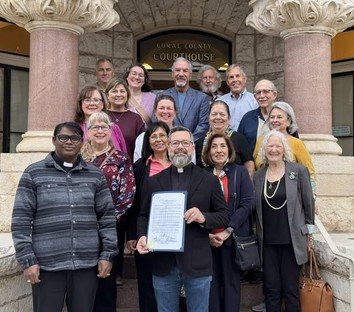
The year in celebration
| Date | Event |
|---|---|
| January 8 | Comal County Commissioners Court proclaims the parish’s 150th anniversary |
| February 7 | Mardi Gras party, hosted by the Catholic Daughters |
| February 14–15 | Parishioners trace their handprints for the altar decorations on St. Joseph’s feast |
| Fridays in Lent | Knights of Columbus fish fries; Stations of the Cross in English and Spanish, alternating between the Hill of the Cross and the main church; children’s Stations on the Hill (March 6 and 20); 150th Anniversary Fiesta medals go on sale |
| March 19 | Solemnity of St. Joseph, patron of the parish |
| April 18 | “Painting Our History”: parishioners paint the White Chapel or St. Rita |
| May 3 | 10 a.m. anniversary Mass scheduled with Archbishop Gustavo García-Siller; every family receives a commemorative gift |
| June 6 | Cookie baking contest |
| June 27 | Bilingual Lotería night, with dinner and music |
| July 3 | “Shine Bright in Faith & Unity,” celebrating the nation’s 250th and the parish’s 150th |
| August 8 | Volunteer Appreciation Mass and reception in St. John’s Hall |
| August 15 | Open house and tours of the Immaculate Conception Chapel, the Day Chapel and the main church |
| August 22–23 | Back-to-school blessing, with St. Joseph medals for every backpack |
| September 13 | Parish panoramic photograph scheduled after the 9:30 Mass |
| September 25 | Parish teens ride the parish float in the Comal County parade |
| October 7 | Guided hike of Honey Creek at Guadalupe River State Park |
| October 11 | Parish Festival |
| October 14 | Living Rosary in front of the Day Chapel |
| November 14 | Parish float in the Bulverde Jubilee Parade |
| November 21–22 | 150th Anniversary Christmas ornaments, limited to 500 |
| December 8 | Solemnity of the Immaculate Conception: the anniversary year closes |
The Anniversary Papers
Each month from February to November, the anniversary committee published a newsletter in English and Spanish. Each issue carried one chapter of the parish’s history and a “Window to the Past,” the story of a saint pictured in the stained glass of the Day Chapel. Together the ten issues make a history of the parish and a guide to its oldest windows.
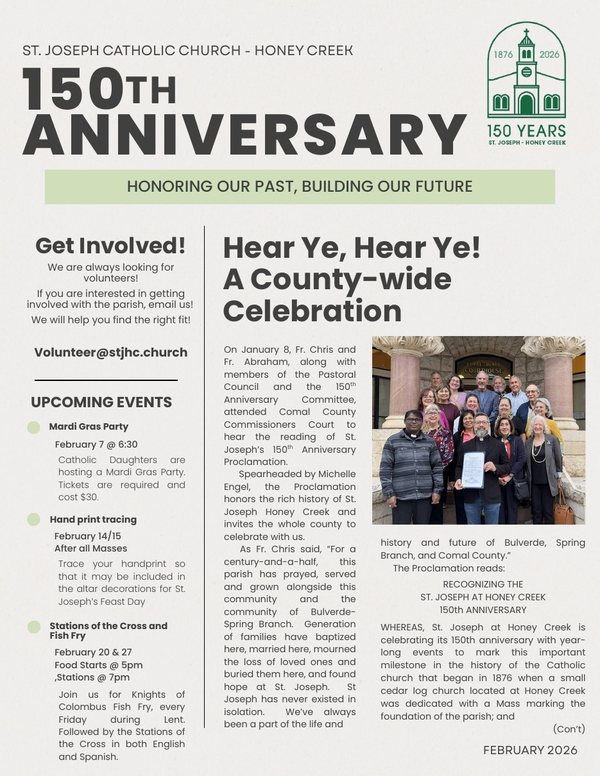 February 2026Hear Ye, Hear Ye! A County-wide Celebration (the Comal County proclamation)The Comal County proclamation honoring the parish’s 150th anniversary, read January 8, 2026.Window to the Past: St. RitaPDF · 1.3 MB (opens in a new tab)
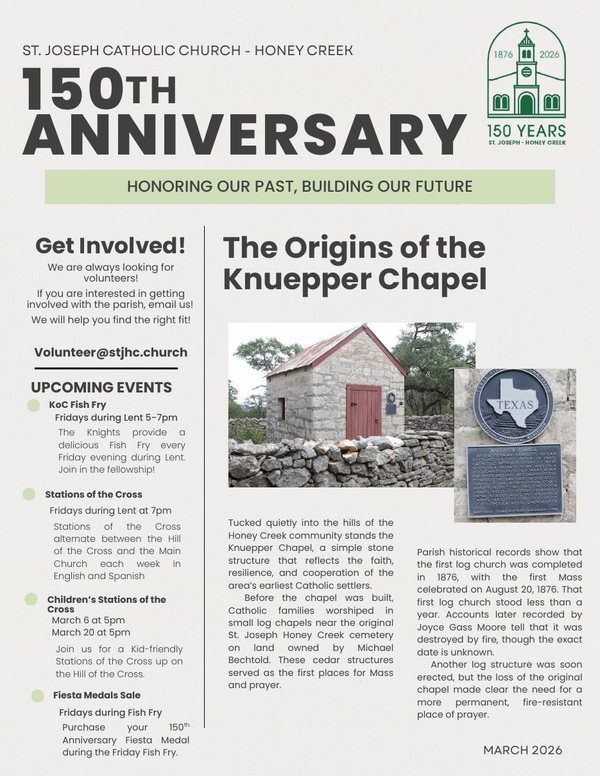 March 2026The Origins of the Kneupper ChapelHow the 1878 Kneupper Chapel came to be built after fire destroyed the first log church.Window to the Past: St. Martin of ToursPDF · 5.6 MB (opens in a new tab)
 April 2026Circuit Priests and St. Joseph – Honey CreekThe circuit-riding priests who served Honey Creek before its first resident pastor arrived in 1898.Window to the Past: St. BarbaraPDF · 2.8 MB (opens in a new tab)
 May 2026The Immaculate Conception ChapelFather Draessel’s hilltop chapel, the first stone building on the present grounds.Window to the Past: St. Francis XavierPDF · 4.9 MB (opens in a new tab)
 June 2026Our Mission Churches: Extending Faith Beyond Honey CreekThe parish’s missions at Twin Sisters (1899) and Spring Branch (1920s).Window to the Past: Sacred Heart of MaryPDF · 3.3 MB (opens in a new tab)
 July 2026Father Virgilius Draessel: Builder of St. Joseph – Honey CreekA profile of the first resident pastor, who built the stone church that is now the Day Chapel.Window to the Past: St. Ignatius of LoyolaPDF · 3.1 MB (opens in a new tab)
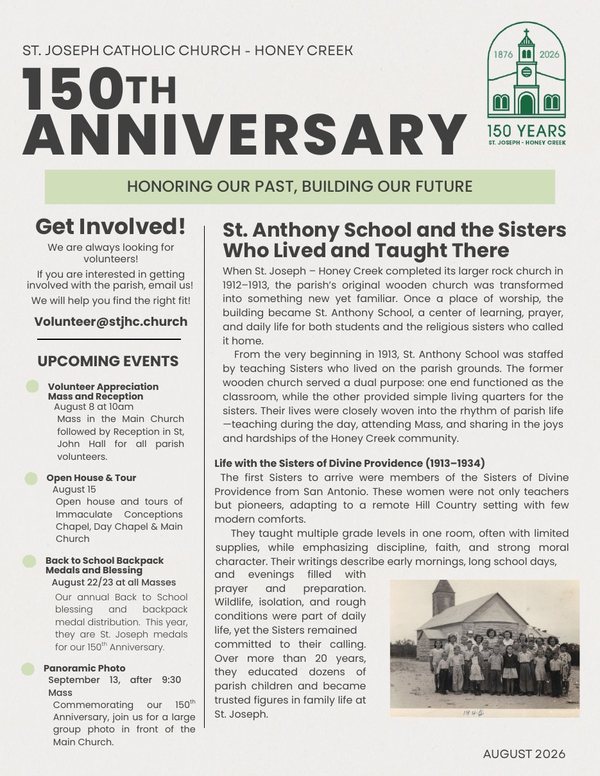 August 2026St. Anthony School and the Sisters Who Lived and Taught ThereThe parish school (1913–1950) and the teaching Sisters who lived there.Window to the Past: St. AnnePDF · 3.7 MB (opens in a new tab)
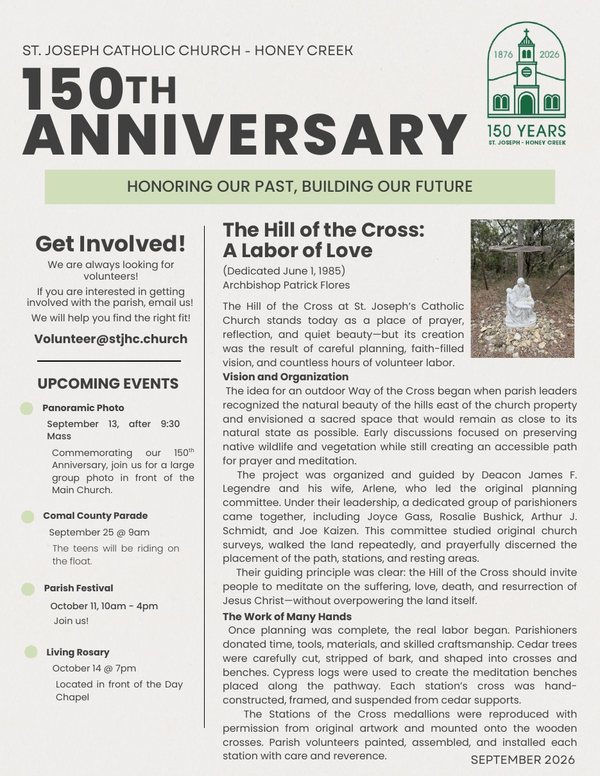 September 2026The Hill of the Cross: A Labor of LoveHow parish volunteers built the outdoor Stations of the Cross, dedicated in 1985.Window to the Past: St. Aloysius GonzagaPDF · 4.3 MB (opens in a new tab)
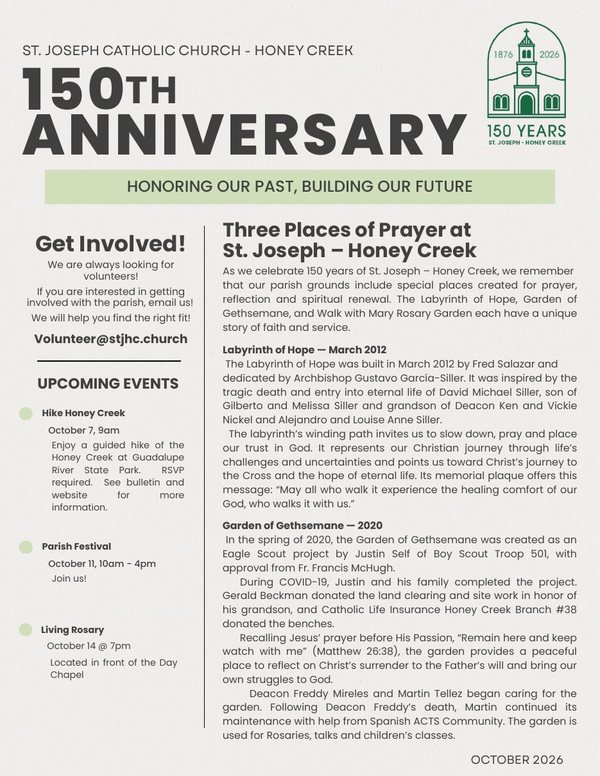 October 2026Three Places of PrayerThe stories behind the Labyrinth of Hope, the Garden of Gethsemane and the Rosary Garden.Window to the Past: St. Anthony of PaduaPDF · 3.2 MB (opens in a new tab)
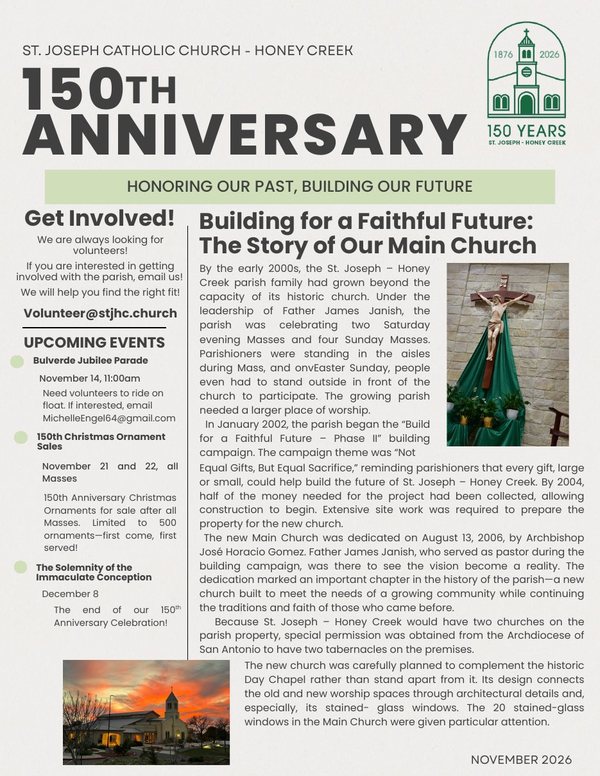 November 2026Building for a Faithful Future: The Story of Our Main ChurchHow the parish built its main church, from the 2002 campaign to the 2006 dedication.Window to the Past: St. JosephPDF · 3.3 MB (opens in a new tab)
